AI Scenario Planning How FP&A Moves From Static Scenarios to Continuous Simulation
Updated: Sep 5
For many finance teams, scenario planning still means three versions of a spreadsheet: base case, downside case, and upside case. That worked when change was slower. It works less well when demand, input costs, hiring plans, interest rates, and cash collections can all move at once.
The pressure is real. Forrester and Anaplan have reported that 64% of finance leaders find complex scenario planning and what-if analysis very or extremely challenging. Workday’s 2026 outlook for financial planning and analysis also points to continuous scenario simulation as an emerging gold standard.
That matters because scenario planning is no longer just a budgeting exercise. It has become a management system. The goal is to see risk early, understand the likely effect, and choose a response before the numbers force one.
AI scenario planning helps finance teams move from a few static cases to a living model that updates as conditions change.
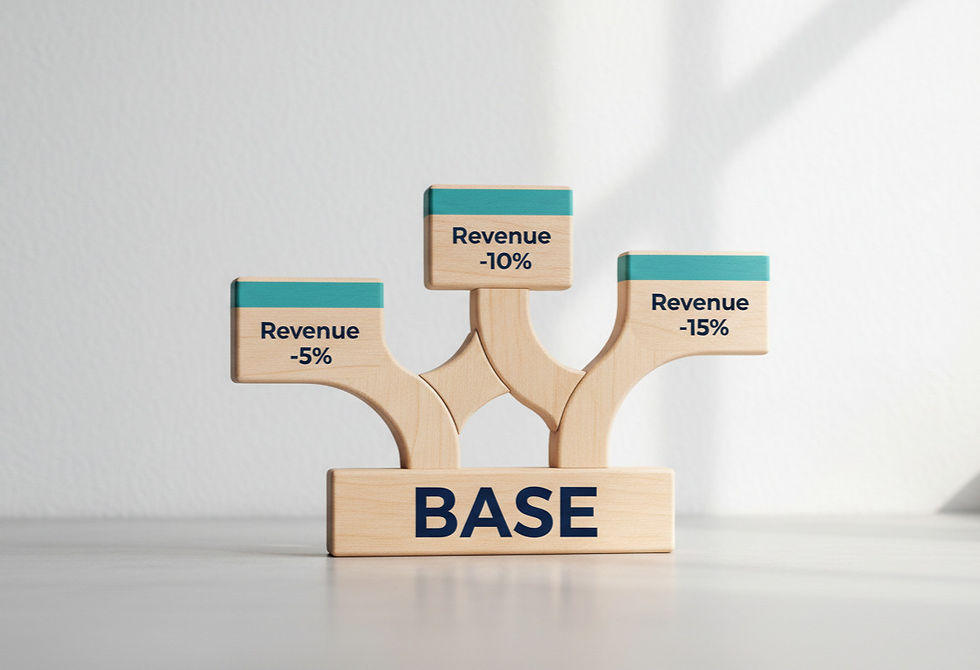
Static scenarios are useful, but they miss the pace of change
Traditional planning usually starts with a simple structure:
BASE
│
├── Revenue -5%
├── Revenue -10%
└── Revenue -15%
↓Margin impact
↓Cash impact
↓EBITDA impact
↓Management response
This is a sensible place to begin. A finance team can ask clear questions.
What happens if revenue falls by 5%?
What happens if the drop reaches 10%?
At what point does cash become tight?
Which cost actions protect margin?
When should management slow hiring or reduce stock purchases?
The problem is that business risk rarely arrives in neat steps. Revenue may fall in one product line but rise in another. Volume may decline while average selling price improves. Customers may pay more slowly at the same time suppliers ask for faster payment. A single “revenue down 10%” case cannot show those moving parts clearly.
Static scenarios also age quickly. A downside case built in March may not reflect the trading pattern seen in April and May. By the time the team refreshes it, the business may already be making decisions with old assumptions.
That is why many planning teams are shifting from fixed scenarios to continuous simulation.
Financial planning and analysis, often shortened to FP&A, is the finance function that turns budgets, forecasts, and performance data into decision support. In that context, better scenario planning is not about producing more spreadsheet tabs. It is about building a repeatable way to connect events, financial impact, and management action.
Continuous simulation changes the question finance can answer
Static planning asks, “What if this happens?”
Continuous simulation asks, “What is happening now, what could it become, and what should we do next?”
That shift is important. A continuous model can update as new information arrives. It can test many linked assumptions rather than one broad percentage change. It can show which risks matter most and which ones are noise.
A basic static model might test this:
Scenario | Revenue assumption | Main output |
Base | 0% change | Current plan remains valid |
Downside 1 | Revenue -5% | Margin pressure begins |
Downside 2 | Revenue -10% | Cash controls may be needed |
Downside 3 | Revenue -15% | Management action becomes urgent |
A continuous model adds movement and timing.
Signal | Trigger | Model response |
Sales volume | Falls by more than 5% for two consecutive months | Activate downside scenario |
Gross margin | Drops below target for one month | Recalculate profit and cash outlook |
Customer payments | Average payment time worsens | Increase cash risk score |
Stock levels | Stock rises while sales fall | Test working capital pressure |
Hiring costs | Run rate exceeds plan | Reforecast staff cost and profit |
This is where artificial intelligence can help. It can monitor many signals at once, spot patterns earlier, and refresh assumptions faster than a manual process. It does not replace judgement. It gives the finance team a clearer starting point for judgement.
A useful continuous simulation has four parts:
A current base case
This is the latest view of expected revenue, costs, cash, and profit.
Linked business drivers
These are the inputs that actually move the numbers, such as volume, price, churn, renewals, wage cost, supplier prices, and payment timing.
Trigger rules
These tell the model when a scenario should switch on.
Management responses
These are pre-agreed actions, such as slowing recruitment, delaying spend, changing prices, reducing stock orders, or drawing on a credit facility.
Without all four, the model is just a forecast. With all four, it becomes a live decision tool.

AI can automate the repetitive work behind better scenarios
The most valuable use of artificial intelligence in planning is often practical and unglamorous. It can reduce the manual work that stops teams from running scenarios often enough.
For example, a finance team may spend days collecting data, cleaning files, checking formulas, and rebuilding charts before the real discussion begins. AI-assisted tools can help by finding unusual movements, grouping related changes, and suggesting which assumptions need review.
In plain terms, AI can support scenario planning in five ways.
It can monitor leading indicators
A leading indicator is a signal that changes before the final financial result appears.
For example:
Website enquiries may weaken before sales orders fall.
Sales volume may drop before revenue falls fully.
Customer payment delays may appear before cash becomes tight.
Supplier price changes may hit margin before profit falls.
Staff absence or overtime may show delivery pressure before service levels fall.
A traditional forecast may not catch these signals until month-end reporting. A continuous model can use them earlier.
It can refresh assumptions more often
Manual planning often runs on a monthly cycle. That makes sense for formal reporting, but some risks move faster.
Artificial intelligence can help update assumptions when fresh data becomes available. If sales volume weakens, the forecast can test the effect on revenue, margin, cash, and earnings before interest, taxes, depreciation, and amortisation. Many teams use that earnings measure as a rough view of operating performance, though it should not be treated as cash.
The point is not to create a new official forecast every day. The point is to keep an early warning view alive between formal cycles.
It can test combinations that humans may miss
A 10% revenue fall is easy to model. A 6% volume fall, a 2% price increase, a 4% rise in supplier costs, and slower customer payments are harder to assess quickly.
AI-supported simulation can run many combinations and rank them by likely impact. That helps the finance team focus on the few scenarios that could really affect decisions.
For example, a modest revenue decline may be manageable if cash collections stay healthy. The same revenue decline may become serious if customers start paying 15 days later than usual.
It can explain variance in plain language
A good planning process needs more than numbers. It needs a clear explanation of what changed and why.
A helpful system might produce a draft summary such as:
Revenue is tracking 6% below plan for the second month. The impact is concentrated in lower-margin products. Cash risk has increased because customer payment times have also lengthened. The downside scenario should be reviewed.
That draft still needs finance review. But it gives the team a faster route to a useful discussion.
It can connect scenarios to decisions
The best scenario plan ends with action. If the model shows a cash issue but no agreed response, the work is incomplete.
Possible responses might include:
Pause non-essential spending.
Delay hiring for roles not yet accepted.
Review supplier order quantities.
Tighten credit control.
Adjust promotional pricing.
Rephase capital projects.
Prepare lender or investor updates earlier.
The response should match the severity of the trigger. A small miss may require closer monitoring. A sustained drop may require immediate action.

Trigger-based scenarios make planning faster and more disciplined
Trigger-based scenarios are one of the clearest ways to make scenario planning more useful.
A trigger is a pre-defined condition that tells the team when to activate, review, or retire a scenario. It removes some of the delay and debate from the process.
For example:
```"
If volume declines by more than 5% for two consecutive months
→ activate downside scenario.
``"
That single rule improves the planning process in three ways.
First, it creates discipline. The team does not wait for a general feeling that performance is weakening.
Second, it links a business signal to a financial model. The volume decline flows through revenue, margin, cash, and profit.
Third, it prompts a management response. The model is not just describing a problem. It is supporting a decision.
A more complete trigger framework could look like this:
Area | Trigger | Scenario action | Management question |
Demand | Volume down more than 5% for two months | Activate downside revenue case | Should spend be reduced now? |
Margin | Gross margin down two points from plan | Test supplier cost and price scenarios | Can price or mix offset the drop? |
Cash | Cash balance forecast below policy level | Run cash protection case | Which payments or projects can move? |
Customers | Payment days worsen for two months | Increase cash collection risk | Should credit control action increase? |
Capacity | Overtime rises while output falls | Test efficiency case | Is cost rising ahead of demand? |
This approach also helps avoid panic. A trigger does not always mean “take drastic action”. It means “review the agreed scenario and decide based on evidence”.
The best triggers are specific, measurable, and tied to decisions. Weak triggers use vague language such as “sales feel soft” or “costs look high”. Strong triggers use thresholds, time periods, and clear ownership.
Here is a simple example of how a trigger-based model could work in practice:
BASE PLAN
│
├── Monitor monthly sales volume
│
├── If volume down >5% for two consecutive months
│ ↓ │ Activate downside revenue scenario
│ ↓ │ Recalculate margin impact
│ ↓ │ Recalculate cash impact
│ ↓ │ Recalculate earnings impact
│ ↓ │ Recommend management response options
│
└── If volume returns within tolerance
↓ Retire downside scenario or keep under watch
The phrase “within tolerance” simply means the result has returned to an acceptable range. Each business should define that range based on its own risk appetite and cash position.
How to build a practical continuous simulation model
A strong model does not need to start big. In fact, the safest route is to begin with the few drivers that matter most.
A practical build might follow this path.
Start with one business question
Do not begin with every possible risk. Start with a question management already cares about.
For example:
What happens if sales volume falls for two months?
What happens if supplier costs rise faster than prices?
What happens if customers pay later?
What happens if a key product line underperforms?
What happens if hiring continues while revenue slows?
A clear question keeps the model grounded.
Map the financial chain
The model should show how one change flows through the business. The chain might look like this:
Volume decline
↓Revenue decline
↓Lower use of capacity
↓Margin pressure
↓Cash pressure
↓Lower earnings
↓Management response
This chain is often more useful than a large table of numbers. It helps leaders see cause and effect.
Set thresholds before the pressure arrives
Trigger rules work best when agreed in advance. If a team sets the rule only after performance weakens, it may be influenced by hope, fear, or internal politics.
A simple threshold might be:
Revenue trigger
If monthly revenue is more than 7% below plan for two months,
review the downside plan at the next weekly trading meeting.
A cash trigger might be:
Cash trigger
If the 13-week cash forecast falls below the agreed minimum level,
start the cash protection plan within five working days.
The numbers should fit the business. A company with thin margins and tight cash may need earlier triggers. A company with stronger reserves may accept more movement before acting.
Keep human review in the loop
AI can suggest scenarios, update assumptions, and flag risks. It should not make major financial decisions on its own.
The finance team still needs to check data quality, challenge assumptions, and understand the commercial context. A model may see that volume has fallen. It may not know that a customer delayed an order for one week, or that a price rise changed buying behaviour in a temporary way.
Good governance is simple:
Name the owner of each trigger.
Record the assumption source.
Keep a change history.
Review the model after major decisions.
Compare past scenarios with actual results.
That last point is often missed. Scenario planning improves when teams learn which triggers were useful and which created false alarms.

What good looks like
Good scenario planning does not create endless forecasts. It creates a clearer rhythm for decisions.
A strong AI-supported process should give finance teams:
A live base case that reflects recent performance.
A small set of high-value downside and upside scenarios.
Trigger rules that activate scenarios when conditions change.
Clear links from business drivers to revenue, margin, cash, and earnings.
Management response options that are ready before a crisis.
A review process that improves the model over time.
The change is cultural as much as technical. Static scenarios encourage teams to ask, “Which version of the plan are we in?” Continuous simulation encourages a better question: “What has changed, what could happen next, and what are we prepared to do?”
This article is for general information only and should not be treated as financial advice.
FAQ
What is AI scenario planning?
AI scenario planning uses artificial intelligence to help update forecasts, test different outcomes, and flag risks based on changing data. It supports human decision-making rather than replacing it.
How is continuous simulation different from a normal forecast?
A normal forecast is usually updated on a set cycle, often monthly or quarterly. Continuous simulation can refresh key assumptions between cycles and show how new signals may affect revenue, margin, cash, and earnings.
What is a trigger-based scenario?
A trigger-based scenario starts when a defined condition is met. For example, if sales volume falls by more than 5% for two months in a row, the finance team may activate a downside scenario and review response options.
Does AI remove the need for finance judgement?
No. AI can process data and suggest patterns, but finance teams still need to check assumptions, understand context, and recommend decisions. Human review is essential.
What should a team model first?
Start with one high-value risk, such as falling sales volume, margin pressure, or slower customer payments. Build the trigger, financial impact, and management response before adding more scenarios.
The takeaway
The old three-scenario model still has value, but it is no longer enough on its own. A base case with revenue down 5%, 10%, and 15% gives a useful frame. Continuous simulation makes that frame active.
The next step is to choose one trigger that matters, connect it to the financial chain, and agree what action follows. That is how scenario planning moves from a static planning file to a living management tool.
Disclaimer: This content is informational only and does not replace legal, tax, regulatory, or financial advice.


Comments